Artificial Intelligence / Foundations
AI, machine learning, deep learning, generative AI, and LLMs
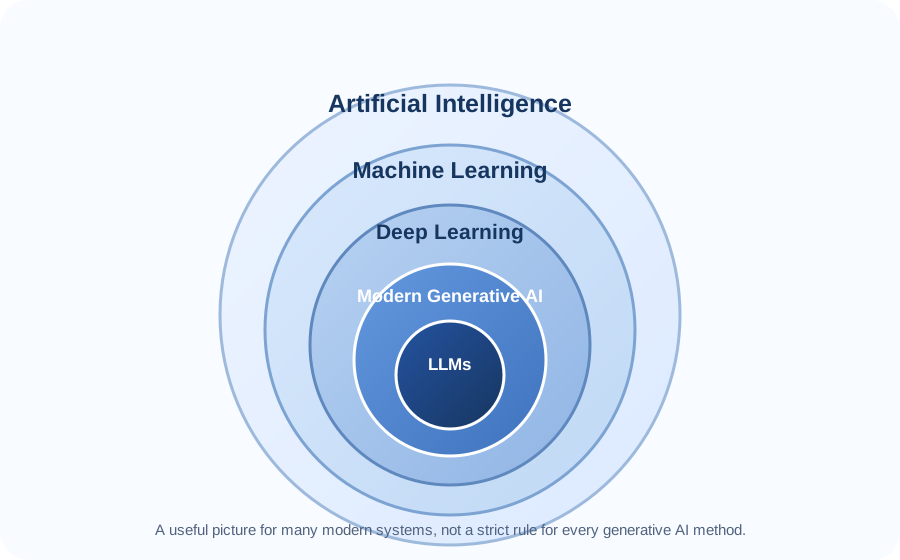
These names describe connected ideas. Deep learning is part of machine learning, and machine learning is part of artificial intelligence. Many modern generative AI tools and large language models fit inside this larger picture.
What is artificial intelligence?
Artificial intelligence (AI) is a broad field focused on making computers do tasks that usually need human abilities, such as understanding language, recognizing images, or making decisions.
Some AI systems follow rules written by people. Other systems learn patterns from examples. Machine learning is one way to build AI.
What is machine learning?
Machine learning (ML) is a type of AI where a computer learns patterns from data instead of being given every rule by hand.
For example, show a program many labeled pictures of cats and dogs. It can learn patterns that help it guess whether a new picture shows a cat or a dog. The examples are called training data.
What is deep learning?
Deep learning is a type of machine learning that uses layered structures called neural networks. These layers learn increasingly detailed patterns from data.
Deep learning is useful for tasks such as recognizing speech, identifying objects in images, and generating text. It often needs many examples and substantial computing power.
How do the three ideas fit together?
- AI is the broad goal: computers perform tasks that seem intelligent.
- ML is one approach to AI: computers learn patterns from data.
- Deep learning is one approach to ML: layered neural networks learn patterns from data.
So, every deep learning system is a machine learning system, and machine learning is part of the wider field of AI. But not every AI system uses machine learning, and not every machine learning system uses deep learning.
A simple example: sorting email
An email program that marks messages as spam can illustrate the difference:
- A rule-based AI might mark any email containing a certain phrase as spam.
- An ML system can learn from examples of spam and ordinary email, then estimate whether a new message is spam.
- A deep learning system can use a layered neural network to learn more complex patterns in message wording and context.
These are simplified examples. Real systems may combine several methods.
Where do generative AI and LLMs fit?
Generative AI: AI that creates
Generative AI is a broad name for AI systems that create new content, such as text, images, audio, video, or code. A text prompt like “write a short story about a fox” asks a generative AI system to create text that fits the request.
Modern generative AI: large models trained with deep learning
Many popular generative AI tools today are built with deep learning. They learn patterns from very large collections of examples, then use those patterns to make new content. Text and image generators are common examples. The word “modern” here refers to these widely used, large-scale deep-learning systems.
Generative AI describes what a system does, while deep learning describes how many modern systems are built. Some generative methods do not use deep learning, so the diagram shows a common modern family rather than every possible method.
LLMs: generative AI focused on language
A large language model (LLM) is a model trained on large amounts of text to recognize and produce language. It can generate answers, summaries, stories, or code. Most well-known LLMs today use deep-learning neural networks. They are one kind of generative AI when used to create text.
In short: an LLM is focused on language; generative AI also includes systems that create other kinds of content, such as images or audio.
Where should you start?
Start with basic Python and data. Jupyter Notebook lets you experiment with code, and NumPy helps you work with numerical data. You can explore both lessons on the Artificial Intelligence page.